skip to main |
skip to sidebar
 The Power of Myth
by
Joseph Campbell
I have had this book for a long time and have read parts now and then. I have watched the video of the TV Series with Bill Moyers and Joseph Campbell which the book documents. I decided to really read 'The Power of Myth' chapter by chapter, word by word. Most of the time I did not understand what I was reading, but at other times the words inspired me. This lead to the following passages that I wanted to save to read again. Maybe some day I will read the book again to see if the words make sense to me after a period of time and experience has passed. Joseph Campbell's basic words to live by have been in my vocabulary since I watched that video. "Follow Your Bliss"
The following are those words that I want to ponder.
Page 12:
Moyers: So there are mythological rituals at work in our society. The ceremony of marriage is one. The ceremony of the inauguration of a President or judge is another. What are some other rituals that are important in society today?
Campbell: Joining the army, putting on a uniform, is another. You're giving up your personal life and accepting a socially determined manner of life in the service of the society of which you are a member. That is why I think it is obscene to judge people in terms of civil law for performances that they rendered in time of war. They were acting not as individuals, they were acting as agents of something above them and to which they had by dedication given themselves. To judge them as though they were individual human beings is totally improper.
Campbell
Page 17: I don't know what's coming, any more that Yeats* knew, but when you come to the end of one time and the beginning of a new one, it's a period of tremendous pain and turmoil. The threat we feel, and every body feels-well, there is this notion of Armageddon coming, you know?
*refer to Yeats poem "The Second Coming".
Page 28: "Here you have the important transition that took place about 500 B.C. This is the date of the Buddha and of Pythagoras and Confucius ad Lao-tze, if there was a Lao-tzu. This is the awakening of man's reason. No longer is he informed and governed by the animal powers. No longer is he guided by the analogy of the planted earth, no longer by the courses of the planets---but by reason.
Page 56:
Moyers: What is a metaphor?
Campbell: A metaphor is an image that suggest something else...The reference of the metaphor in religious traditions is to something transcendent that is not literally any thing.
Page 57: Campbell: The inner world is the world of your requirements and your energies ad your structure and your possibilities that meets the outer world. And the outer world is the field of your incarnations. That's where you are. You've got to keep both going. As Novalis said, "The seat of the soul is there where the inner and outer worlds meet."
Campbell:
Page 58: There has to be a training to help you open your ears so that you can begin to hear metaphorically instead of concretely.
Page 60: I think the clergy is really not doing its proper work. It does not speak about the connotations of the metaphors but is stuck with the ethics of good and evil.
Page 64: ...You can make a choice, either to throw it all off and go into the forest to meditate, or to stay in the world, both in the life of your job of politics and achievement, and in the love life with your wife and family. Now, this is a very nice myth, it seems to me.
Page 66: Affirmation is difficult. We always affirm with conditions. I affirm the world on condition that it gets to be the way Santa Claus told me it ought to be. But affirming it the way it is--that's the hard thing. and that is what rituals are about.
Page 67: ...Eternity isn't some later time. Eternity isn't even a long time. Eternity has nothing to do with time. Eternity is that dimension of here and now that all thinking in temporal terms cuts off.
And if you don't get it here, you won't get it anywhere. The problem with heaven is that you will be having such a good time there, you won't even think of eternity. You'll just have this unending delight in the beatific vision of God. But the experience of eternity right here and now, in all things whether thought of as good or as evil, is the function of life.
Page 118:
Moyers: What happens when you follow your bliss?
Campbell: You come to bliss. ... We are having experiences all the time which may on occasion render some sense of this, a little intuition of where your bliss is. Grab it. No one can tell you what it is going to be. You have to learn to recognize your depth.
Page 149:
Moyers: What's my ego?
Campbell: What you think you want, what you will to believe, what you think you can afford, what you decide to love, what you regard yourself as bound to.
Page 154:
Moyers: What are the "thou shalts" of a child that he needs to shed?
Campbell: Every one that inhibits his self-fulfillment.
Page 182:
Moyers: So when you say, "Save the earth", we're talking about saving ourselves.
Campbell: Yes. All this hope for something happening in society has to wait for something in the human psyche a whole new way of experiencing a society.
Page 207:
Moyers: As you've moved among various world views, dipping in and out of cultures, civilizations, and religions, have you found something in common in every culture that creates the need for God?
Campbell: Anyone who has had an experience of mystery knows that there is a dimension of the universe that is not that which is available to his senses.
Campbell
Page 229: Just sheer life cannot be said to have a purpose, because look at all the different purposes it has all over the place. But each incarnation, you might say, has a potentiality, and the mission of life is to live that potentiality. How do you do it? My answer is, "Follow your bliss." There's something inside you that knows when you are in the center, that knows when you're on the beam or off the beam. And if you get off the beam to earn money, you've lost your life, And if you stay in the center and don't get any money, you still have your bliss.
View all my reviews
 Washington Irving: An American Original
by Brian Jay Jones
My rating: 5 of 5 stars
This biography gave me a whole new perspective on past history and its heroes. It was slow reading at first, but I gradually found myself drawn to Washington Irving and his life. Along with his story came the history that was unfolding inthe United States and our leaders.
Some of my thoughts-
Fame is fleeting. I remember Washington Irving stories from my grade school days. I think of him as Ichabod Crane from The Legend of Sleepy Hollow and Rip Van Winkle. However, for his time and our time he is so much more that these two stories. I wonder if other people remember him only because of them.
Notes from the book:
"Washington Irving was the first American writer to live by his pen and the first to have an international reputation." He paved the way for authors such as: James Fenimore Cooper, Nathaniel Hawthorne, and Edgar Allen Poe. Their main source of income was not their writing. Irving was constantly trying to find a way to make money. He was educated as a lawyer, but it didn't really suit him. At first he wrote under pseudonyms because he was afraid people wouldn't like what he wrote. His first book, 'A History of New York', was written by Diedrich Knickerbocker. (The New York Knicks owe him their name.)
He always had a wanderlust and headed for England where he found himself running the family trading company. He was helping his brother Peter who was sickly most of his life. He didn't return to the United State until fourteen years later. While there he wrote 'The Sketch Book' and 'Tales of a Traveller' under the name of Geoffrey Crayon. 'The Life and Voyage of Christopher Columbus' was the first publication that carried his name as the author.
He spent several years as a Minister from the United States to the Spanish Court. Finally, he returned home to stay. His crowning achievement was his five volume set, 'The Life of George Washington'. When he was five, he had met and was blessed by George Washington. He had always felt that it was his destiny to do write about his life.
Irving was born in 1783 and died at the age of 76 in 1859. Over his lifetime "Politicians, writers, actors, artists, and wannabes of every type clamored to be associated with him. A friend to six presidents, he had danced with Dolley Madison in the White House, consoled Martin Van Buren in London, flattered a young Queen Isabella in Madrid as John Tyler's minister to Spain. John Jacob Astor tapped him to be his personal biographer, Mary Shelley had a crush on him. Edgar Allen Poe flattered him. Sir Walter Scott loved him. Dickens, Longfellow, and Haw throne adored him. Even those like James Fenimore Cooper who loathed him gave his work their grudging respect." (found on page 408) Washington Irving was the 'Rock Star' of his time.
It took me several months to read this book. There was so much to absorb that I couldn't do it straight through. It was slow reading and it took me a while to warm up to Washington Irving. However, when he died and was laid to rest at Sleepy Hollow I had tears running down my face.
I highly recommend this biography it will give you a real appreciation for Irving and the times in which he lived. Thank you Mr. Jones for such a wonderful tribute.
View all my reviews
 Dispatches from Pluto: Lost and Found in the Mississippi Delta by Richard Grant
My rating: 5 of 5 stars
If you want to join an American subculture hiding in the Delta of Mississippi, this is a great way to do it. Richard Grant*is a Brit who has come to live in the Delta and still lives in Mississippi at this time. He has the personality as an outsider to be able to gain the confidence of the insiders. Also, it helped that he had a British accent. At one point in the book, one black man said: "He's not white, he's British." I loved the Field Trip chapter, but couldn't really understand the significance of Chapter 5, The Oncologist's Hitmen. The chapters that went into depth about the 'Blues' music didn't interest me. I don't give out a lot of '5 stars', this book was definitely a ' five star' book . Good writing and interesting stories that kept me wanting to go to Mississippi and take the Field Trip.
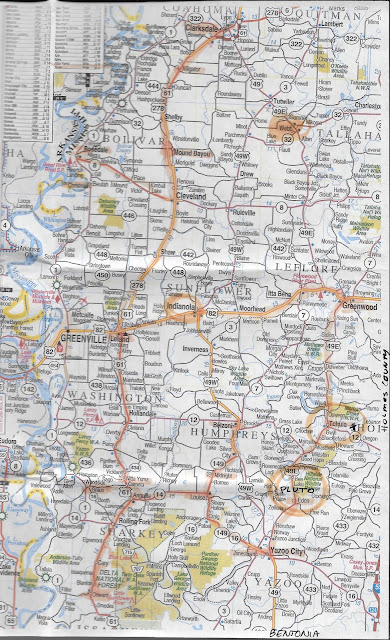 This was my Book Club book for the month for July. It was my turn to lead the discussion. Since I love to know where I am when I read a book; a map was in order. This book especially needed a map for Chapter 6 - Field Trip. I marked a Mississippi map with the route and points of interest and brought copies. It put the story in perspective and helped generate a lot of discussion.
Here are some of my notes:
p. 10 Why is it called Pluto? (Pluto is an unincorporated town and isn't on this map.) It is called Pluto because: "Pluto is the Lord of the Underworld and all of this was just a big mean hell of a swamp."
p. 46 "South whites didn't mind how close blacks got so long as they didn't get too high socially and economically". 1st paragraph
p. 87 Clarksdale was one stop on the Field Trip. Morgan Freeman, the actor, lives here. It is the 'Crossroads' where Robert Johnson supposedly sold his soul to the devil. Crossroads, the movie, will give you a good look at 'the blues' in the Delta.
p. 93 Wet Delta Salad-lettuce with olive oil and vinegar.
(Go to The Faded Rose in Little Rock, Arkansas,
to eat a really good one.) (Facebook link)
p. 104 The blacks were against the civil rights movement.
p. 159 Parchman Prison (Time ran out so we didn't get to discuss the prison and the 'Wage-Hand Program'.)
pps. 174-176 The schools/academies. They were not called private schools and were set up to avoid segregation.
p. 187 Quitman Country Elementary school was an experiment to provide quality education to the Mississippi schools. It worked, but was not continued, because the local school board felt that they were under the control of outsiders.
p. 216 Plantation mentality.
p. 235 Morgan Freeman's 'Meaning of Life'. "The meaning of life for every organism on the planet, including us, is to procreate and die."
p. 257-258 It's a habit.
p. 265 "and some of these women out here be have mo kids, and mo kids, just so they check get bigger."
p. 276 Feudal relic.
Maybe some of my notes will trigger a discussion in your book club if you select Dispatches from Pluto for discussion.
*Richard Grant is an author, journalist, and television host. He currently lives with his wife in Jackson, Mississippi. He was born in Malaysia in 1963 and spent time as a child in Kuwait before his family moved to London where he spent his childhood. He earned a history degree from University College in London and then moved to the United States. He has lived in Tucson, Arizona and New York City.
He grew up with an interest in traveling and writing as evidenced by the books that he has published.
1. American Nomads: Travels with Lost Conquistadors, Mountain Men, Cowboys, Indians, Hoboes, Truckers and Bullriders.
2. God's Middle Finger, Into The Lawless Heart of the Sierra Madre (English title-Bandit Roads, Into the Lawless Heart of the Sierra Madre.) This book was written after he traveled in northern Mexico in the Sierra Madre Occidental, an area nine hundred miles long that contained cave-dwelling Indian tribes and is one of the world's largest areas for production of marijuana and heroin.
3. Crazy River: Exploration and Folly in East Africa tells the story of his travels along the Malagarasi River in Tanzania and other events in Burundi and Rwanda.
4. Dispatches from Pluto